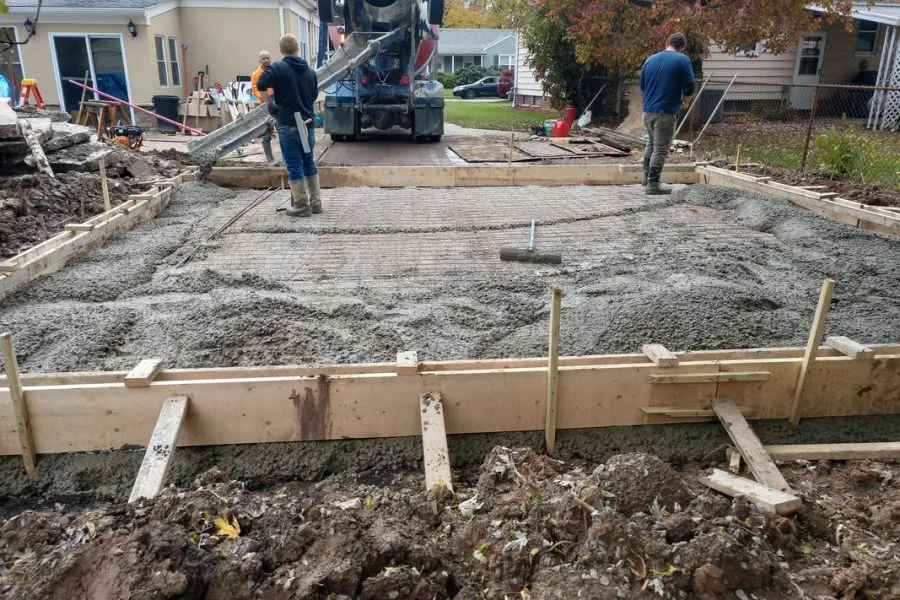
Most home concrete jobs take a few days on site and then about a week before a car goes on the slab. The weather in North Jersey sets when we can pour and how we protect the work.
How long does concrete take to cure?
Concrete reaches its design strength in about 28 days. It gains most of that in the first week. Curing is a chemical reaction with water, so the slab has to be kept from drying too fast and kept from freezing while it happens. Cool weather slows the process down.
How long before I can walk on new concrete?
You can walk on new concrete after 24 to 48 hours in mild weather. Keep dogs, bikes and furniture feet off for a few days more, since they can still mark the surface. In cold weather give it extra time.
How long before I can drive on new concrete?
Wait about 7 days before you drive on new concrete with a car, and longer in cold weather. Keep heavy vehicles such as moving trucks, oil deliveries and dumpsters off for the full 28 days. Stay off the edges, which are the weakest part.
How long does it take to pour a driveway?
A typical driveway takes one to two days of preparation and one day to pour and finish. Preparation covers tear-out, excavation, the stone base and the forms. Add time for a permit, for the utility markout and for any city inspection of the apron. Rain can move the pour day.
Can concrete be poured in the rain?
Concrete should not be poured in the rain if it can be avoided. Light drizzle can be managed with covers. Steady or heavy rain washes cement off the surface and adds water to the mix, both of which weaken the top. We watch the forecast and move the date when rain is likely.
Is it too hot to pour concrete?
It is too hot to pour in the middle of a humid day in the 90s without special care. Hot concrete sets fast and dries at the surface before it can be finished. In summer we pour early, dampen the base, and start curing straight away. Very hot, windy afternoons are skipped.
Can concrete be poured in cold or freezing weather?
Yes, with precautions, down to a point. Fresh concrete must not freeze in its first day or two, and it should never be placed on frozen ground. In cold weather we can use heated mix water, a faster-setting mix and insulated blankets. When hard freezing is forecast day and night, it is too cold and the job waits.
What is the best time of year to pour?
The best time of year to pour in Newark is spring and early fall. Days are mild, nights stay above freezing and the slab cures at a steady pace. Summer works with early starts. Late fall pours carry risk, because the concrete goes into its first winter young. Outdoor work mostly stops in the coldest weeks.
Can I use salt or deicer on new concrete?
No, keep salt and deicer off new concrete for its first winter. After that, use as little as you can. Rock salt increases the number of freeze-thaw cycles in the surface, and products with ammonium nitrate or ammonium sulfate attack concrete chemically. Sand gives grip without damage. Rinse off the salty slush that cars bring in from the road.
What should I do in the first week?
Follow the curing instructions we leave with you. Keep everyone off for the first day, and do not let sprinklers or downspouts run across the fresh surface. If we used a curing compound, do not wash it off. Tell us right away if you see something that worries you.
It was poured in extreme heat and now it looks bad. What went wrong?
Concrete poured in high heat loses water quickly. The top can crust while the body is still soft, which gives crazing, fine surface cracks, a wavy finish and weak, dusty spots. On a July afternoon in Newark a crew needs to start early, wet the base, work in smaller sections and begin curing at once. Light crazing is cosmetic. Dusting and early scaling are not.
To plan a pour around the weather, call (917) 909-5931.